



What Is Sugarcane Bagasse? From Agricultural Byproduct to Food Packaging
Sugarcane bagasse is a versatile plant-based fibre used to create moulded food packaging such as plates, bowls, trays and clamshells. Learn how bagasse is processed and what buyers should know about finished-product performance and claims.
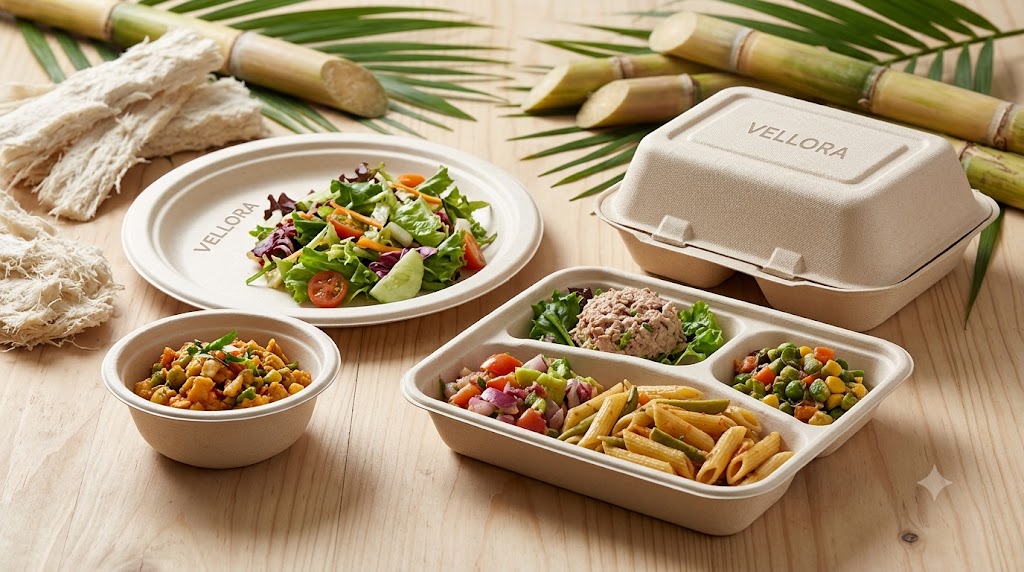
Sugarcane bagasse is the fibrous material that remains after sugarcane juice has been extracted. Instead of being treated only as an agricultural byproduct, this fibre can be processed into pulp and formed into a variety of moulded-fibre food-service and packaging products.
Today, sugarcane bagasse is used in products such as plates, bowls, meal trays and clamshell containers. For businesses looking for alternatives to conventional food-service packaging, understanding what bagasse is—and how the raw material becomes a finished product—is an important first step.
However, the word “bagasse” describes the primary fibre material. It does not automatically describe the complete composition, performance or environmental characteristics of every finished product.
What Is Sugarcane Bagasse?
Bagasse is the fibrous residue left after extracting juice from sugarcane.
Sugarcane contains valuable juice as well as fibrous plant material. Once the juice has been extracted, the remaining fibre can be processed for other applications.
For moulded food packaging, suitable bagasse fibre is processed into pulp and then formed into specific shapes.
This makes bagasse different from simply using raw agricultural residue as a finished packaging material. The fibre goes through processing and forming before becoming a usable plate, bowl, tray or container.
From Sugarcane Fibre to Moulded Food Packaging
The general production route can be understood as a series of stages:
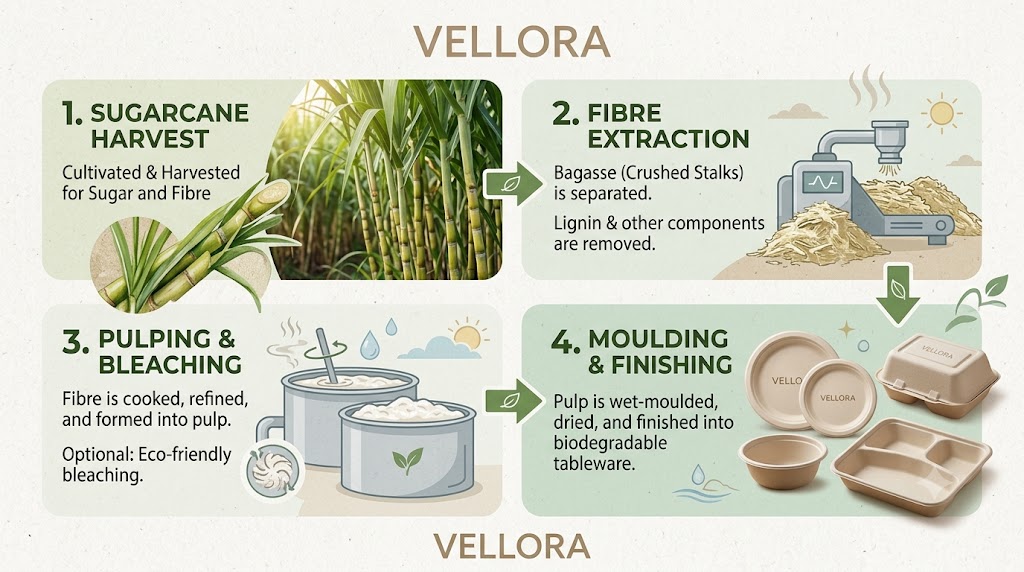
Sugarcane → Juice extraction → Bagasse fibre → Pulp preparation → Moulding → Pressing/drying → Trimming and finishing → Finished product
The exact manufacturing process can vary depending on the product, equipment, formulation and required specifications.
1. Sugarcane Processing
Sugarcane is processed to extract its juice.
The remaining fibrous material is bagasse.
2. Fibre Preparation
The suitable fibre is prepared for pulp processing.
The objective is to create a material that can be processed and formed into the required product geometry.
3. Pulp Formation
The prepared fibre is processed into pulp.
Pulp characteristics can influence the consistency and forming behaviour of the finished material.
4. Moulding
The pulp is introduced into moulds designed for the required product.
Different moulds can produce different formats, including:
- Plates
- Bowls
- Trays
- Compartment trays
- Clamshell containers
- Other food-service packaging formats
5. Pressing and Drying
The moulded material is pressed and dried to create the required shape and structure.
This stage contributes to the physical form and rigidity of the finished product.
6. Trimming and Finishing
After forming, products may be trimmed and finished to achieve the required dimensions and appearance.
The finished SKU can then be inspected and packed according to its intended commercial specification.
What Is Moulded-Fibre Packaging?
Sugarcane bagasse tableware belongs to the broader category of moulded-fibre food packaging.
Moulded fibre refers to products formed from fibre-based material into a specific shape using moulding processes.
The term describes the manufacturing format rather than automatically guaranteeing a particular environmental or performance characteristic.
This distinction is important for buyers.
A product can be made using plant fibre while still having specific requirements related to:
- Product construction
- Fibre formulation
- Additives
- Surface treatments
- Coatings
- Food-contact suitability
- Temperature performance
- Compostability claims
Therefore, buyers should evaluate the complete finished product rather than relying only on the material name.
What Products Can Be Made From Bagasse?
Bagasse can be formed into a wide range of food-service products.
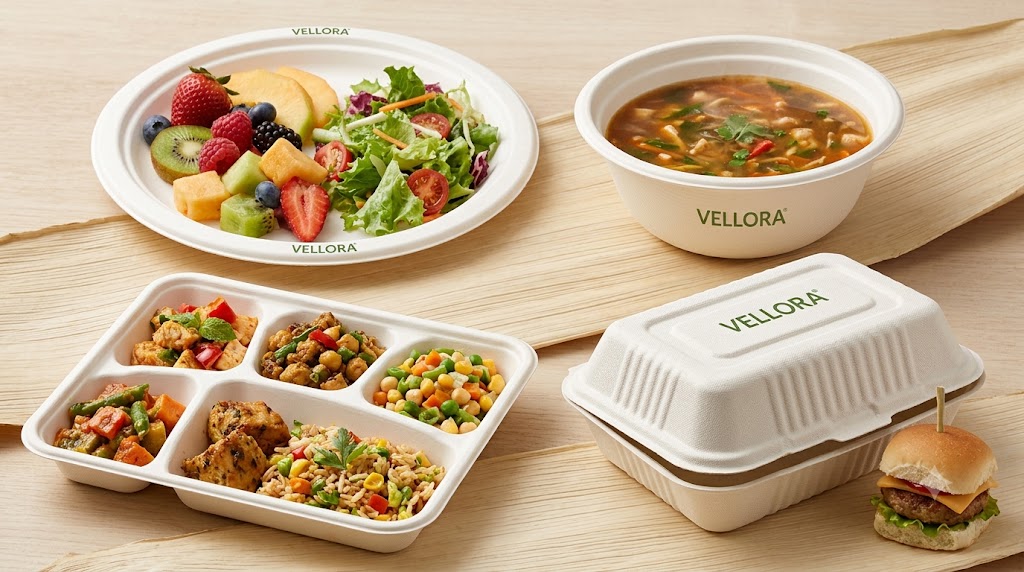
Bagasse Plates
Plates can be produced in different shapes, sizes and compartment configurations.
Common applications include:
- Catering
- Events
- Restaurants
- Takeaway meals
- Institutional food service
- Retail food-service packaging
Bagasse Bowls
Bowls provide additional depth for foods that are difficult to serve on a flat plate.
Depending on the product design, they can be used for:
- Rice dishes
- Salads
- Desserts
- Snacks
- Mixed meals
- Other food-service applications
The exact food application should always be matched with the tested performance of the selected product.
Bagasse Meal Trays
Meal trays can include multiple compartments designed to separate different components of a meal.
They can be useful where portion organization and separation are important.
Bagasse Clamshell Containers
Clamshells combine a base and hinged lid into one container.
They are commonly considered for takeaway and food-delivery applications where closure, stacking and transport performance are important.
Is Every Bagasse Product the Same?
No.
Two products can both be described as bagasse products while having different dimensions, weights, shapes, construction and performance characteristics.
For example, a bagasse plate designed for immediate meal service may have different requirements from a clamshell intended for takeaway delivery.
Important product characteristics can include:
- Dimensions
- Product weight
- Wall structure
- Depth
- Compartment layout
- Rigidity
- Lid compatibility
- Oil and moisture resistance
- Temperature conditions
- Packaging configuration
This is why commercial buyers should evaluate the exact SKU rather than making decisions based only on the word “bagasse.”
Bagasse Material vs Finished-Product Claims
One of the most important distinctions for buyers is the difference between the base material and the finished product.
The fact that a product uses sugarcane bagasse as its primary fibre does not automatically establish every environmental or technical claim associated with the finished product.
For example, buyers may encounter claims relating to:
- Compostability
- Biodegradability
- Plastic-free construction
- PFAS-free status
- Food-contact suitability
- Microwave suitability
- Freezer suitability
These claims should be evaluated separately and supported by appropriate product-specific information.
A general statement about the raw material should not automatically be treated as proof of a claim about the complete finished product.
Why Product Construction Matters
The final performance of moulded-fibre packaging can depend on more than the fibre itself.
Product design, fibre formulation, additives, surface treatment and manufacturing quality can all influence how a finished item behaves.
For example, a buyer evaluating packaging for oily or moist food may need to consider resistance to oil and moisture over the intended holding period.
A buyer using packaging for hot food may need to evaluate performance at the expected serving temperature.
A takeaway operator may place greater importance on:
- Closure security
- Hinge strength
- Stackability
- Spill resistance
- Transport performance
The correct product is therefore the one that matches the application—not simply the one with the most attractive material description.
White and Natural-Brown Bagasse Products
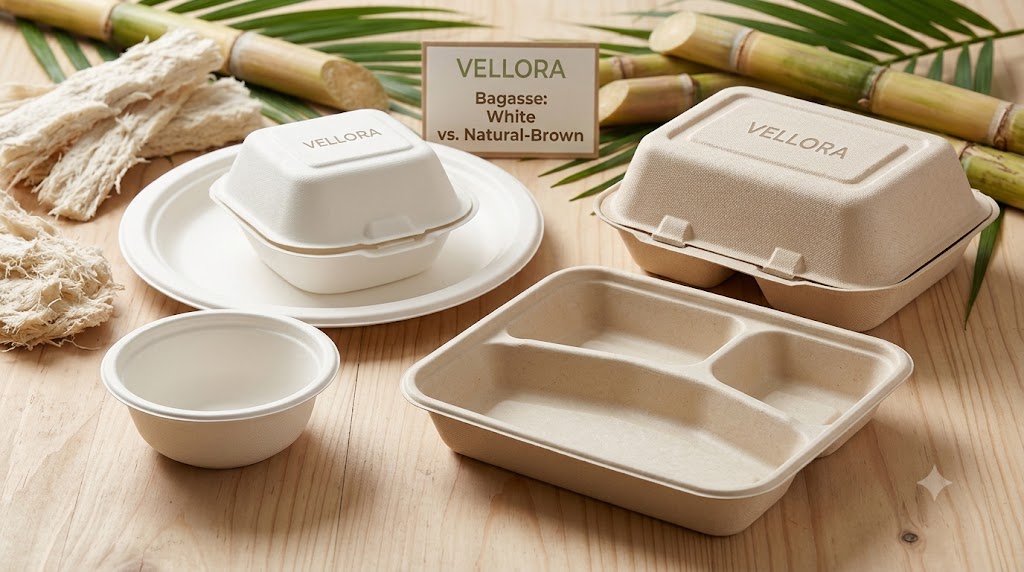
Bagasse tableware can be available in different visual finishes, including white and unbleached natural-brown options.
White products can provide a clean, neutral appearance that may suit hospitality, catering, institutional service and broad retail ranges.
Unbleached natural-brown products provide a more natural fibre appearance and may suit brands using natural, organic or kraft-style visual positioning.
However, colour should not be treated as proof of a product’s environmental or technical characteristics.
A natural-brown product is not automatically compostable, and a white product is not automatically unsuitable for environmental packaging programs.
Those claims should be confirmed separately for the exact product.
What Should Buyers Check?
Once a buyer understands the difference between bagasse as a material and the finished product, the next step is to evaluate the actual SKU.
Important information can include:
Product Specifications
- Product dimensions
- Capacity
- Product weight
- Compartment configuration
- Compatible lid information
- Packaging configuration
Intended Application
- Type of food
- Hot, chilled or room-temperature use
- Dry, oily, moist or liquid food
- Immediate service or takeaway
- Expected holding time
- Delivery conditions
Product Documentation
Depending on the destination market and intended claims, buyers may request:
- Material or product declaration
- Food-contact documentation
- Product specification sheet
- PFAS-related documentation
- Compostability documentation where applicable
- Batch or lot information
- Quality documentation
The exact requirements depend on the destination market, intended use and claims being made.
Why Testing Matters
Product descriptions are useful for initial evaluation, but physical samples provide an opportunity to test the product under real operating conditions.
A buyer can evaluate:
- Appearance
- Dimensions
- Rigidity
- Load performance
- Oil and moisture resistance
- Lid fit
- Closure performance
- Stackability
- Temperature behaviour
- Delivery performance
The best testing process uses the actual food, temperature, holding time and transport conditions expected in normal operations.
This helps buyers identify potential problems before committing to a large order.
Bagasse Tableware for International Markets
For international buyers, product selection is only one part of the sourcing process.
Packaging configuration and export requirements can also influence the commercial decision.
Buyers should consider:
- Pieces per carton
- Carton dimensions
- Net and gross weight
- Pallet configuration
- Container loading
- Labelling requirements
- Minimum order quantity
- Production lead time
- Destination
- Incoterm
- Required documentation
A product that appears competitive based on unit price may have a different landed-cost position once packaging and freight volume are considered.
Why Choose Bagasse Tableware From India?
India has an established agricultural and manufacturing ecosystem around sugarcane and fibre-based products.
For international buyers, sourcing from India can provide access to a range of moulded-fibre food-service formats and manufacturing partners.
However, buyers should still evaluate each supplier and product individually.
The key questions remain:
- Does the product match the application?
- Are specifications clearly defined?
- Are samples available?
- Is supporting documentation available?
- Can the supplier maintain consistent production?
- Are packing and export requirements understood?
- Can the commercial terms support the buyer’s target market?
Sourcing Bagasse Products Through VELLORA OVERSEAS
VELLORA OVERSEAS works as a B2B export and sourcing partner connecting international buyers with trusted manufacturing partners in India.
The company focuses on helping buyers identify suitable food-service packaging products according to their product requirements, quantities, destination markets and packaging needs.
Its product range includes bagasse plates, bowls, meal trays, clamshells and related food-service products.
For buyers considering bulk sourcing, the process should begin with a clear product requirement rather than a generic request for “bagasse products.”
Sharing the intended application, product format, quantity, destination and packaging requirements allows the appropriate specifications to be reviewed before quotation.
Frequently Asked Questions
What is sugarcane bagasse?
Sugarcane bagasse is the fibrous material that remains after sugarcane juice has been extracted. It can be processed into pulp and moulded into food-service and packaging products.
Is bagasse plastic?
Bagasse is a plant-based fibre material rather than conventional petroleum-based plastic. However, buyers should evaluate the complete finished product, including any additives, coatings or other components.
What can be made from sugarcane bagasse?
Bagasse can be processed into moulded-fibre products such as plates, bowls, meal trays and clamshell containers, among other food-service packaging formats.
Is every bagasse product compostable?
Not automatically. Compostability is a claim about the finished product and should be supported by appropriate documentation for the specific product.
Is bagasse suitable for hot food?
Many bagasse products are designed for food-service applications involving hot food, but performance varies by product construction and conditions of use. The exact SKU should be tested with the intended food and temperature.
What is the difference between bagasse and moulded fibre?
Bagasse refers to the sugarcane-derived fibre material. Moulded fibre describes a broader category of fibre-based products formed into specific shapes. Bagasse can therefore be used as a material for moulded-fibre food packaging.
Conclusion
Sugarcane bagasse is more than an agricultural byproduct. When processed into suitable pulp and moulded into finished products, it can become a versatile material for food-service packaging.
But choosing bagasse packaging should not stop at the raw material.
For commercial buyers, the important question is whether the finished product matches the intended food, service format, performance requirements, documentation needs and export conditions.
Understanding the difference between the raw material, moulded-fibre manufacturing process and finished-product claims gives importers, distributors and food-service buyers a stronger foundation for evaluating bagasse tableware.
If you are sourcing bagasse tableware from India, define your required product format, application, quantity, destination and packaging requirements before requesting a quotation.
Ready to Source Bagasse Tableware From India?
Share your product requirements, estimated quantities, destination market and packaging preferences with VELLORA OVERSEAS to discuss suitable bagasse tableware sourcing options.