



How to Choose Sugarcane Bagasse Tableware: A B2B Buyer’s Guide
Choose the right sugarcane bagasse tableware for your business with this practical B2B buyer’s guide. Learn how to evaluate plates, bowls, trays and clamshells based on food application, dimensions, performance, documentation, packaging, MOQ and export requirements.
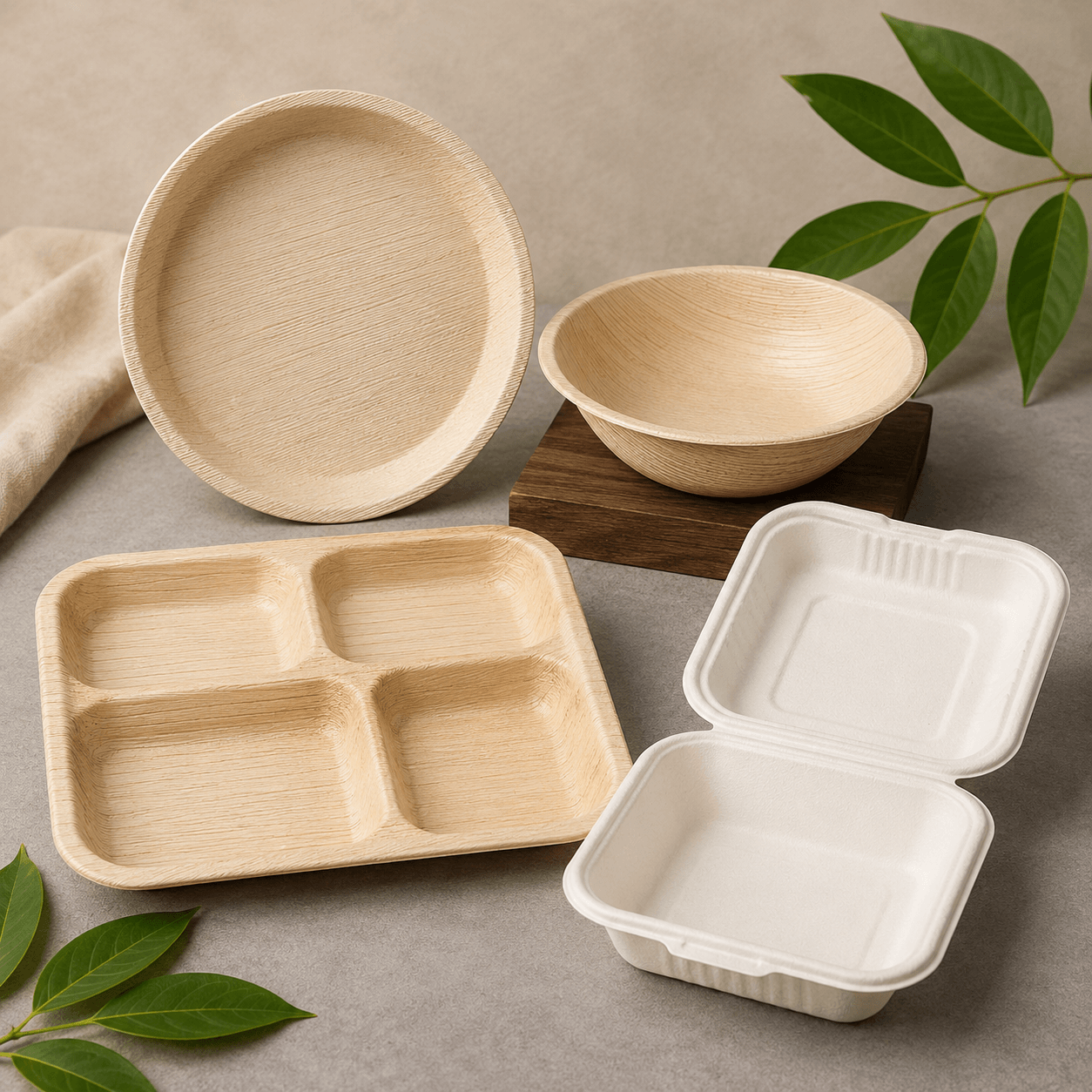
Choosing sugarcane bagasse tableware for a business is not simply a matter of finding a plate or container made from plant fibre. Two products that look similar in a catalogue may differ in dimensions, rigidity, lid fit, resistance to oil and moisture, carton configuration, supporting documents and suitability for a particular meal.
For importers, distributors and food-service buyers, those differences affect more than product performance. They influence landed cost, storage, customer satisfaction, compliance review and the ability to reorder the same specification consistently.
This guide explains how to select bagasse plates, bowls, meal trays and clamshell containers using a practical B2B process—from defining the food application to preparing a complete request for quotation.
What Is Sugarcane Bagasse Tableware?
Bagasse is the fibrous material that remains after juice is extracted from sugarcane. For tableware production, suitable fibre is processed into pulp, formed in moulds, pressed or dried, trimmed and finished as food-service products.
Common formats include:
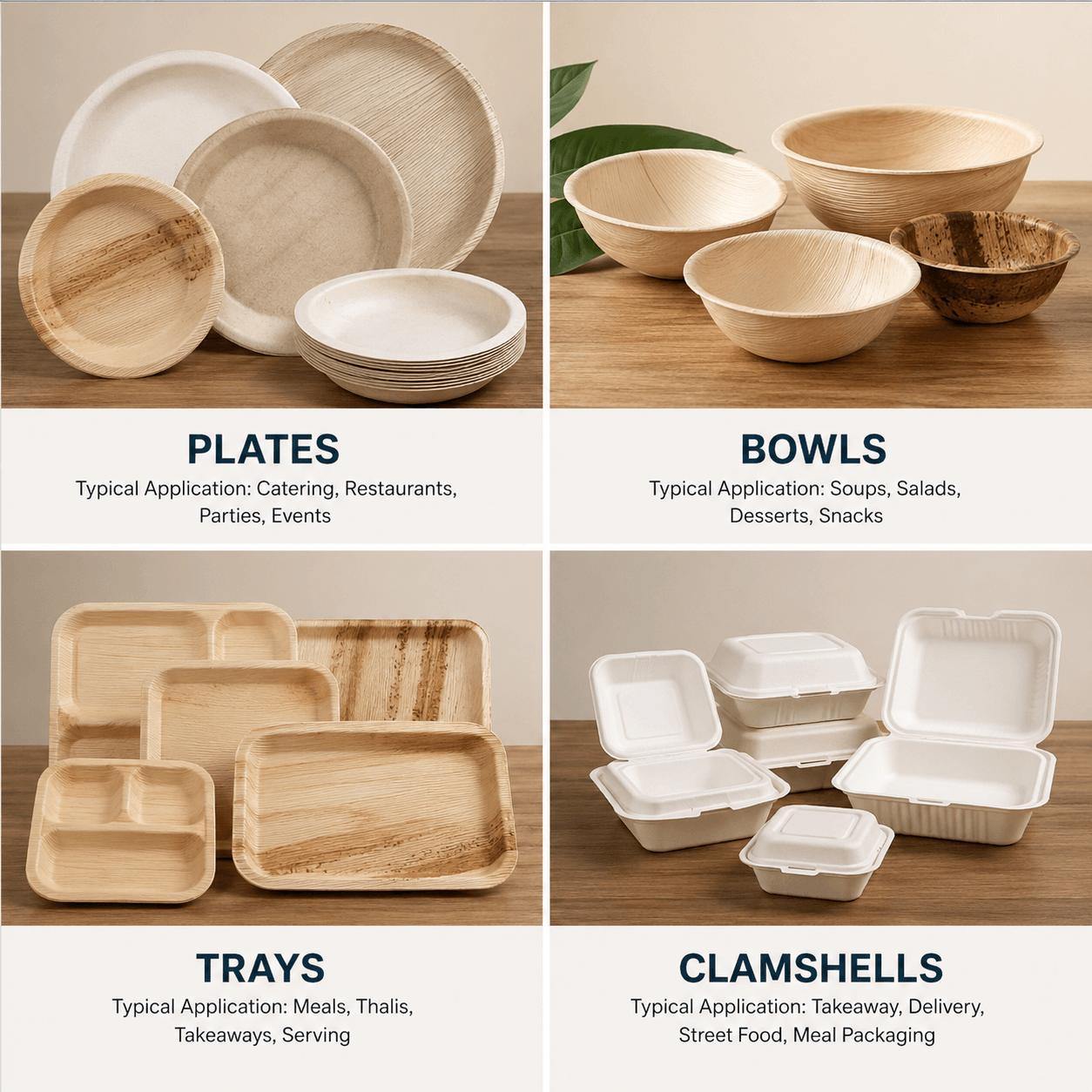
- Round, square and compartment plates
- Bowls and containers, with or without compatible lids
- Single- and multi-compartment meal trays
- Plain and compartment clamshell containers
- Beverage cups and compatible fibre lids
The result belongs to the broader category of moulded-fibre food packaging. However, the raw material alone does not determine the performance or environmental claim of the finished item. Product design, fibre formulation, additives, surface treatment and manufacturing quality can all matter.
Buyers should therefore assess the exact stock-keeping unit, or SKU, rather than relying only on the word “bagasse.”
Start With the Food and Service Application
The most reliable selection process begins with the meal, not the catalogue. Define what the packaging must hold, how it will be filled and how long it must perform before deciding on a product.
| Food-Service Requirement | Format to Evaluate | Important Points to Confirm |
|---|---|---|
| Desserts, snacks or light portions | Small plates or shallow trays | Diameter, depth and rigidity |
| Main meals served immediately | Round or square plates | Portion size, load strength and edge stability |
| Meals with separate components | Compartment plates or meal trays | Compartment volume, divider height and spill-over risk |
| Takeaway meals and food delivery | Clamshells or containers with lids | Closure, hinge strength, stackability and ventilation |
| Rice, curries or mixed meals | Deep trays, bowls or compartment trays | Depth, oil/moisture resistance and lid compatibility |
| Soups or highly liquid foods | Purpose-tested bowls with matching lids | Leak testing, seal security and transport conditions |
| Hot or cold beverages | Compatible cup-and-lid system | Rim diameter, fit, temperature conditions and drinking opening |
The exact product should be tested with the buyer’s real food, filling temperature, holding time and delivery conditions.
An Eight-Step Process for Selecting Bagasse Tableware
1. Define the Exact End Use
Begin with a written use case. A buyer should be able to answer:
- What food will the product hold?
- Is the food dry, oily, moist or liquid?
- Will it be served hot, chilled or at room temperature?
- Is the product used for immediate service, takeaway or delivery?
- How long will the food remain in the container?
- Will customers reheat or refrigerate it?
- Will the filled product be stacked during transport?
“Suitable for food” is too broad for procurement. A tray used for dry bakery items has a different performance requirement from a container used for hot curry during a 45-minute delivery.
2. Select the Product Format and Compartment Layout
Choose the format that supports portioning and service efficiency.
A round bagasse plate may suit plated meals, catering and buffet service. Compartment plates or trays can help keep sides separate and support portion control. Clamshells combine a base and hinged lid for takeaway service, while separate-lid containers may be better where presentation, stacking or closure security is important.
More compartments are not automatically better. Each compartment must be large enough for the intended food, and divider height should be assessed when sauces or gravies are involved.
3. Confirm Dimensions and Usable Capacity
Do not approve a product only from a name such as “9-inch plate” or “1,000 ml bowl.” Request a specification sheet or drawing and confirm:
- External length and width, or diameter
- Internal usable dimensions
- Product depth or height
- Nominal and practical filling capacity, where applicable
- Individual product weight or agreed weight tolerance
- Lid dimensions and compatible product code
- Compartment dimensions for divided formats
Nominal capacity may not equal a comfortable working fill. Likewise, two products with the same outer size may provide different usable areas because of rim width, wall angle or compartment design.
Physical samples should be checked against the buyer’s existing shelves, sealing process, display space, transport crates and customer expectations.
4. Evaluate Functional Performance Using the Real Application
Supplier descriptions can help with shortlisting, but sample testing should determine suitability.
Depending on the application, evaluate:
- Rigidity when the product is filled and lifted
- Resistance to oil and moisture over the required holding period
- Leakage or seepage with the intended food
- Deformation at the expected serving temperature
- Lid fit, hinge movement and closure retention
- Stack stability when empty and filled
- Product separation during high-speed service
- Odour, appearance and surface consistency
- Behaviour under reheating, chilling or freezing conditions, if required
Claims such as microwave-safe or freezer-safe should be confirmed for the exact SKU and the supplier’s stated conditions of use.
5. Confirm the Material, Finish and Product Construction
Ask whether the product is white or unbleached natural brown, whether other plant fibres are included, and whether any coating, additive or treatment is used to improve water or grease resistance.
This matters because buyers may need to support environmental or material claims in their own market.
For every shortlisted SKU, request the available evidence for claims such as:
- Material composition
- Food-contact suitability
- PFAS-free status
- Compostability
- Biodegradability
- Plastic-free construction
The evidence should clearly identify the product, material or product family it covers. A general logo or unrelated certificate should not replace SKU-relevant documentation.
6. Review Food-Contact and Market Documentation
Food packaging requirements vary by destination and intended use. The buyer or importer remains responsible for confirming what is required in the target market.
Depending on the destination and claim, a buyer may request:
- Material or product declaration
- Food-contact test reports or compliance support
- PFAS-related declaration or test documentation
- Compostability certification where a compostable claim will be used
- Product specification sheet
- Batch or lot traceability information
- Quality-management documentation
- Samples from the intended production specification
Environmental claims should also be precise. “Compostable” should not be treated as a universal disposal instruction without considering the certified product, required composting conditions and locally available waste system.
7. Compare Packing Efficiency—not Only Unit Price
For an international order, carton data can materially affect the landed cost.
Request:
- Pieces per inner pack
- Inner packs per master carton
- Total pieces per carton
- Carton dimensions
- Net and gross carton weight
- Pallet configuration, if required
- Estimated container loading quantity
- Packing material and labelling format
A lower unit price can become less competitive if the product uses inefficient cartons, creates excessive freight volume or does not match the distributor’s preferred pack size.
Retail and private-label buyers should additionally confirm barcode placement, artwork specifications, label language, master-carton marks, packaging approval process and minimum quantity for customization.
8. Align the Product Decision With Commercial and Export Terms
Before final approval, confirm:
- Minimum order quantity by SKU
- Whether multiple products can be combined in one shipment
- Sample cost and courier arrangement
- Production and packing lead time
- Price validity and currency
- Incoterm and named port or destination
- Inspection arrangement
- Payment terms
- Required export and shipping documents
- Procedure for specification changes or quality claims
Vague RFQs often produce quotations that cannot be compared fairly.
Ask each potential supply partner to quote against the same product specification, quantity, packing configuration and delivery term.

White or Unbleached Bagasse Tableware?
Both white and natural-brown products can be suitable for commercial use. The decision is often based on market positioning, product availability and the required visual presentation.
| Consideration | White Bagasse Tableware | Unbleached Natural-Brown Tableware |
|---|---|---|
| Appearance | Clean, neutral presentation | Natural fibre appearance |
| Common brand fit | Hospitality, events, institutional service and broad retail ranges | Natural-positioned brands, organic ranges and kraft-style packaging systems |
| Visual consistency | Surface marks may be less noticeable depending on the product | Natural shade and fibre variation may be more visible |
| Buyer check | Confirm bleaching or processing information and supporting claims | Confirm material statement and supporting claims |
Colour alone does not prove compostability, food-contact suitability or the absence of a particular substance. Verify those points separately for the selected SKU.
A Practical Sample-Evaluation Checklist
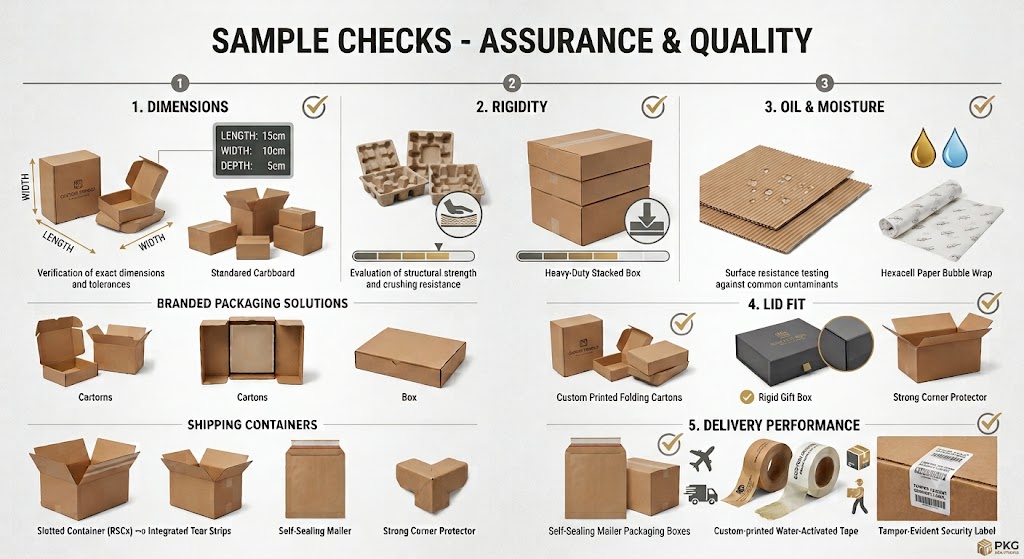
Use the same test procedure for every shortlisted sample and record the result.
| Test | What to Do | What to Record |
|---|---|---|
| Visual inspection | Review a representative sample quantity | Colour, surface, trimming, cracks, shape and consistency |
| Dimension check | Measure key dimensions and weigh samples | Range and variation against specification |
| Load test | Fill with the intended meal and lift normally | Bending, hand stability and base support |
| Oil/moisture test | Hold the intended food for the required time | Softening, staining, seepage or leakage |
| Closure test | Open and close the product; stack filled units | Hinge condition, lid fit and reopening |
| Temperature test | Use the required hot, cold or reheating condition | Deformation, loss of rigidity, odour or other change |
| Delivery simulation | Pack, stack and transport as the customer would | Spills, lid movement, crushing and presentation |
Keep one approved reference sample and the signed specification so that future production can be compared against the agreed standard.
Information to Include in a Bagasse Tableware RFQ
A complete request for quotation should include:
- Product type: plate, bowl, tray, clamshell, cup or lid.
- Required dimensions, capacity and compartment count.
- White or unbleached natural-brown finish.
- Intended food and service application.
- Required quantity by SKU.
- Preferred inner-pack and master-carton configuration.
- Destination country and delivery location or port.
- Required Incoterm, such as EXW, FOB or CIF.
- Target compliance documents and environmental claims.
- Private-label, artwork, barcode or custom-packaging requirements.
- Sample-testing requirements.
- Desired shipment timeline.
This information allows the exporter or sourcing partner to identify the appropriate product and return a commercially comparable quotation.
Sourcing Bagasse Tableware Through VELLORA OVERSEAS
VELLORA OVERSEAS works as a B2B export and sourcing partner connecting international buyers with trusted manufacturing partners in India.
Its current product range includes plates, bowls, meal trays, clamshells and related bagasse food-service items.
Depending on the selected product and order quantity, the company can coordinate product selection, specification confirmation, bulk-order planning, customized packaging or private-label requirements, export documentation and shipment arrangements.
Buyers should share the exact product, quantity, destination and intended use so that available specifications and documentation can be confirmed before quotation.
Frequently Asked Questions
Is bagasse the same as sugarcane fibre?
In this product category, “bagasse” generally refers to the fibrous material remaining after sugarcane juice extraction. It is processed into pulp and moulded into tableware and food-packaging formats.
Are all bagasse products compostable?
Do not assume that every finished product carries the same claim. The base fibre, additives, coatings, inks and other components can affect the claim.
Ask for documentation covering the exact product and confirm whether the claimed composting condition matches the destination market’s available facilities.
Can bagasse tableware hold hot, oily or moist food?
Many bagasse products are designed for common hot and cold food-service applications, but performance varies by product construction and use conditions.
Test the exact SKU with the real food, temperature and required holding time.
Should a buyer choose white or unbleached bagasse products?
Choose according to customer preference, brand positioning, available specifications and supporting documentation.
Colour alone does not establish product performance or environmental credentials.
What should I send when requesting a quotation?
Send the product type and size, quantity by SKU, intended application, destination, required Incoterm, packing preference, documentation requirements and any private-label needs.
The more precise the RFQ, the easier it is to compare products and commercial terms.
Ready to Evaluate Bagasse Tableware for Your Market?
Share your required product formats, quantities, destination and packaging preferences with VELLORA OVERSEAS to receive a specification-based sourcing and export proposal.